




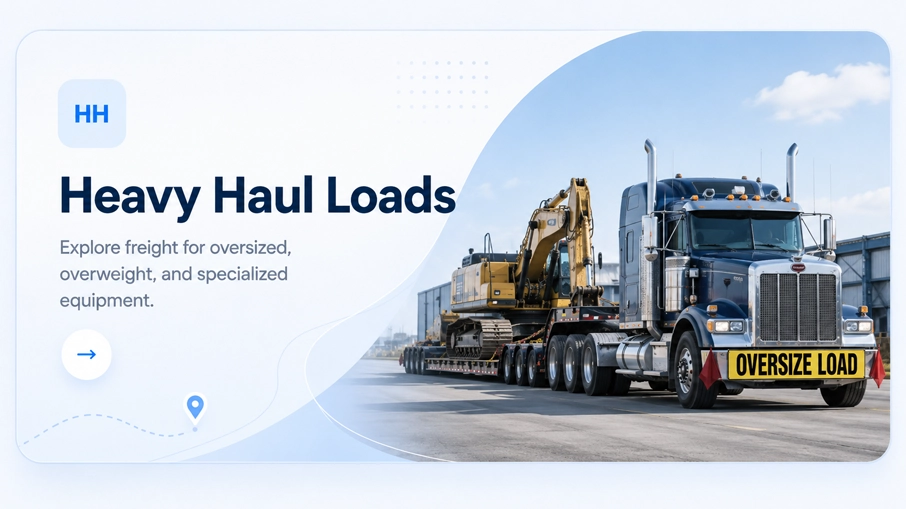
Heavy Haul Loads | Find Oversized & Specialized Freight
Heavy Haul Loads for Oversized & Specialized Freight
Find heavy haul loads for oversized, overweight, and specialized freight. Whether you operate a lowboy, RGN, step deck, or other specialized trailer, heavy haul freight can connect your equipment with demanding transportation opportunities across construction, industrial, energy, infrastructure, and machinery markets.
What Are Heavy Haul Loads?
Heavy haul loads involve freight that requires specialized transportation because of its size, weight, dimensions, or handling requirements. Instead of moving standard palletized freight inside an enclosed trailer, heavy haul carriers often transport large machinery, construction equipment, industrial components, and other unusually sized cargo.
Because these shipments can exceed conventional freight dimensions, the equipment used to move them may also be more specialized. Lowboy trailers, removable gooseneck trailers, step decks, multi-axle configurations, and extendable trailers can all play a role depending on the freight.
In addition, heavy haul transportation often requires more planning than a standard truckload shipment. Route limitations, cargo dimensions, loading procedures, securement, and applicable permit requirements can all affect how a load is transported. Therefore, carriers should review each shipment carefully before accepting it.
Heavy Haul Freight May Include:
- ✓ Oversized construction and earthmoving equipment
- ✓ Industrial machinery and manufacturing equipment
- ✓ Large generators, compressors, and power equipment
- ✓ Agricultural and forestry machinery
- ✓ Infrastructure and specialized project cargo
Types of Heavy Haul Loads
Heavy haul freight can cover many industries. However, these categories are among the most common opportunities for specialized carriers and owner-operators.
Construction Equipment
Excavators, bulldozers, loaders, graders, cranes, and other machinery often require specialized trailers because of their weight, height, or overall dimensions.
Industrial Machinery
Manufacturing equipment, presses, large machine components, and factory machinery can create specialized freight opportunities for properly equipped carriers.
Energy Equipment
Generators, power-generation components, transformers, and related equipment may require additional planning because of their size and handling requirements.
Agricultural Machinery
Tractors, combines, harvesters, and other large agricultural machines can be well suited to lowboy, RGN, or specialized open-deck transportation.
Infrastructure Cargo
Large structural components and project freight used in infrastructure development can require specialized hauling equipment and careful route coordination.
Specialized Project Freight
Some shipments simply do not fit standard trailer dimensions. As a result, customized trailer configurations or additional transportation planning may be required.
Equipment Used for Heavy Haul Freight
The right trailer depends on the freight's dimensions, weight, loading method, and destination. Consequently, heavy haul carriers often operate one or more specialized trailer configurations.
Removable Gooseneck Trailers
RGN trailers allow the front of the trailer to detach, creating a ramp that can make loading self-propelled machinery considerably easier.
Lowboy Trailers
A low deck height can help accommodate taller machinery while keeping the overall transported height lower than it would be on many standard trailers.
Step Deck Trailers
Step decks provide a lower main deck than a standard flatbed and can be useful for freight that needs additional vertical clearance.
Extendable Trailers
Extendable or stretch configurations can support unusually long freight when standard trailer deck length is not sufficient.
How to Find Heavy Haul Loads
Finding the right shipment begins with knowing exactly what your equipment can handle. From there, you can evaluate freight based on the details that matter most to your operation.
Choose Your Equipment
Identify the trailer type, deck dimensions, axle configuration, and equipment capabilities available for the shipment.
Review the Freight
Compare cargo dimensions, weight, origin, destination, loading requirements, and any other important shipment information.
Evaluate the Route
Consider whether the proposed route is appropriate for the load and review any special transportation requirements that may apply.
Book the Right Load
Once the freight matches your equipment and operation, move forward with the opportunity that best fits your business.
Why Carriers Look for Heavy Haul Loads
Heavy haul transportation serves freight that standard equipment often cannot accommodate. Therefore, carriers with specialized trailers, experience, and operating capabilities can pursue a distinct segment of the freight market while putting specialized assets to work.
Heavy Haul Planning Matters
Unlike many standard truckload shipments, heavy haul freight may involve additional operational considerations. For example, oversized or overweight cargo can be affected by route restrictions, bridge clearances, loading conditions, and jurisdiction-specific requirements.
Therefore, carriers should confirm the load's dimensions and weight, verify that their equipment is appropriate, and evaluate the proposed route before dispatch. When required, permits, escorts, or other transportation arrangements should also be addressed before the shipment moves.
Most importantly, requirements can differ by jurisdiction and shipment. Each heavy haul load should be evaluated individually rather than treated like a standard freight move.
Review Before Booking
- ✓ Cargo length, width, height, and total weight
- ✓ Trailer type and available deck dimensions
- ✓ Loading and unloading requirements
- ✓ Route and clearance considerations
- ✓ Applicable permits or additional transport requirements
Explore More Load Types
Heavy haul is only one type of freight opportunity. Depending on your equipment, you can also explore additional load categories available through Logistware.
Frequently Asked Questions About Heavy Haul Loads
Learn more about specialized freight, trailer equipment, and the considerations involved in transporting heavy haul shipments.
What is considered a heavy haul load?
A heavy haul load generally involves freight that requires specialized transportation because of its weight, size, dimensions, or handling requirements. Examples can include large construction equipment, industrial machinery, and oversized project cargo.
What equipment is used for heavy haul loads?
Equipment can include lowboy trailers, removable gooseneck trailers, step decks, multi-axle trailers, and extendable configurations. The appropriate trailer depends on the cargo dimensions, weight, loading method, and route.
Are heavy haul loads and oversize loads the same?
The terms are closely related but are not always identical. Heavy haul describes specialized transportation involving unusually large or heavy freight, while an oversize load generally refers to cargo exceeding applicable dimensional limits. The exact classification can depend on the shipment and jurisdiction.
Do heavy haul loads require special permits?
Some shipments may require permits or additional transportation arrangements when they exceed applicable size or weight limits. However, requirements vary by jurisdiction, route, and shipment, so carriers should verify the applicable requirements before moving the load.
What freight is commonly moved as heavy haul?
Common freight can include excavators, bulldozers, agricultural machinery, generators, industrial machinery, infrastructure components, and other large equipment that may not be suitable for standard trailers.
Can owner-operators find heavy haul loads?
Yes. Owner-operators with suitable equipment and operating capabilities can search for heavy haul freight that matches their trailer configuration and business. However, each load should be reviewed carefully to ensure the equipment and operational requirements are a proper match.
Start Exploring Heavy Haul Loads
Put your specialized equipment to work. Browse heavy haul freight opportunities and find oversized, overweight, and specialized loads that match your operation.